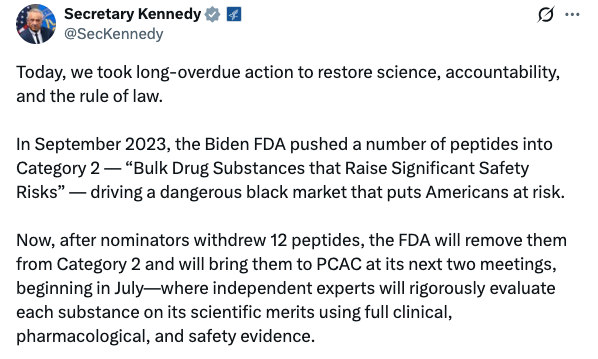
The U.S. FDA is starting a new review process for 12 peptides that were previously restricted. This decision comes after support from Robert F. Kennedy Jr., who said the goal is to restore science, accountability, and proper regulation.
The announcement has also gained attention after Donald Trump Jr. publicly supported the move, calling it “Amazing news!!!”
But what does all of this actually mean?
Let’s break it down in simple words.
If you’re exploring peptides for research purposes, you may also want to take a look at Orion Peptides as a potential supplier.
They offer a range of research-grade peptides, and you can use the coupon code Grab10 at checkout to receive a 10% discount if you choose to order.
What Happened Before? (2023 FDA Decision)
In September 2023, the FDA placed several peptides into something called Category 2.
What is Category 2?
- It means the FDA believes a substance may have safety risks
- Pharmacies are not allowed to compound (make) these peptides
- Access becomes very limited
Because of this, many people turned to unregulated sources, which increased safety risks.
What Is Happening Now?
According to RFK Jr.’s statement:
- 12 peptides are being removed from Category 2
- They are now being sent for scientific review
- The review will be done by a panel called PCAC
What Is PCAC? (Simple Explanation)
PCAC = Pharmacy Compounding Advisory Committee
In simple terms:
- It is a group of independent medical and science experts
- They review drugs and compounds
- They check:
- Safety
- Effectiveness
- Scientific data
They do not approve drugs directly, but they give recommendations to the FDA.
Timeline: What Happens Next?
Based on the official update:
📅 Step 1: Removal from Category 2 (Now)
- The 12 peptides are no longer in the “high-risk” restricted group
📅 Step 2: PCAC Meetings (Starting July 2026)
- Experts will review each peptide one by one
- They will study clinical and safety data
📅 Step 3: FDA Decision (After Review)
- The FDA will decide:
- Allow compounding
- Keep restrictions
- Or require more research
Important: This process takes time. Nothing is approved yet.
Full List of the 12 Peptides That Are Headed For Review
Here are the peptides now headed for review:
- BPC-157
- Thymosin Beta-4 Fragment (LKKTETQ)
- Epitalon
- GHK-Cu (injectable)
- MOTS-c
- DSIP (Emideltide)
- Dihexa Acetate
- Ibutamoren Mesylate
- Melanotan II
- KPV
- Semax (heptapeptide)
- Cathelicidin LL-37
What Does Research Say About These Peptides?
Note: The benefits below are based on research studies only, not approved medical use.
1. BPC-157
Studied for:
- Tissue healing
- Muscle and tendon repair
Mostly tested in animal studies.
2. Thymosin Beta-4
Studied for:
- Wound healing
- Cell repair
May support tissue regeneration in early research.
3. Epitalon
Studied for:
- Anti-aging effects
- Telomere activity
Research is limited and mostly experimental.
4. GHK-Cu
Studied for:
- Skin repair
- Collagen production
Often researched in regenerative medicine.
4. MOTS-c
Studied for:
- Metabolism
- Energy regulation
Linked to mitochondrial function in early studies.
5. DSIP (Emideltide)
Studied for:
- Sleep regulation
- Stress response
Data is limited and not fully proven.
6. Dihexa Acetate
Studied for:
- Brain function
- Memory support
Mostly early-stage neurological research.
7. Ibutamoren Mesylate
Studied for:
- Growth hormone release
- Muscle and bone health
More human data exists compared to other peptides, but still not FDA-approved.
8. Melanotan II
Studied for:
- Skin pigmentation
- UV protection
Has known side effects and safety concerns.
9. KPV
Studied for:
- Anti-inflammatory effects
- Gut health
Early research suggests immune system benefits.
10. Semax
Studied for:
- Cognitive function
- Focus and memory
Used in some countries, but not FDA-approved.
11. Cathelicidin LL-37
Studied for:
- Immune response
- Antimicrobial effects
Research focuses on infection and inflammation.
Why This Matters
This decision could change the peptide industry in three big ways:
1. More Regulation
Instead of banning peptides, the FDA may bring them under controlled and safer access
2. Reduced Black Market
Legal pathways could reduce the need for unsafe, unverified products
3. More Research
Each peptide will now be judged based on real scientific data.
Where Orion Peptides Fits In
As the market evolves, quality matters more than ever.
Orion Peptides is known as a trusted source for research-based peptides, focusing on:
- High-quality standards
- Transparency
- Products intended for research use only
For researchers and professionals, choosing a reliable vendor is critical during this transition phase.
Final Thoughts
The FDA’s decision to review these 12 peptides is a major step forward—but it is not approval.
With backing from RFK Jr. and public support from Donald Trump Jr., the conversation is shifting toward:
Science-based decisions instead of blanket restrictions
The next few months—especially the July PCAC meetings—will decide the future of these peptides.