The peptide industry may be on the verge of a major shift.
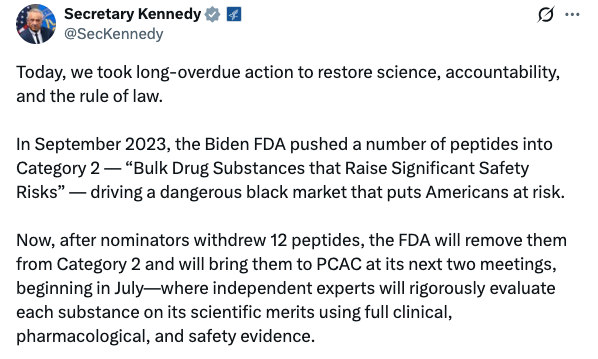
Robert F. Kennedy Jr. has publicly supported a move to reconsider several peptides that were restricted by the FDA in 2023. Now, the agency is preparing to review these compounds again, signaling a possible change in policy that could impact patients, clinics, and the growing peptide market.
Adding to the momentum, Donald Trump Jr. reacted to the announcement by calling it “Amazing news!!!”, amplifying the conversation and drawing national attention.
If you are looking to buy peptides for research purposes, I would suggest to buy it from Orion Peptides.
Don’t forget to use the coupon code Grab10 for 10% instant discount at Checkout.
What Happened: From Restriction to Reconsideration
In 2023, the FDA placed multiple peptides into Category 2, meaning they were considered to pose potential safety risks and were not allowed for routine compounding.
These restrictions were based on concerns such as:
- Lack of human clinical data
- Possible toxicity or immune reactions
- Quality and sterility issues
Now, the FDA plans to re-evaluate several of these peptides through its advisory panel, known as the Pharmacy Compounding Advisory Committee (PCAC), starting in July.
This includes well-known compounds like:
- BPC-157
- GHK-Cu
- MOTS-c
- Epitalon
- Semax
RFK Jr.’s Position: Expanding Access Through Regulation
RFK Jr. has been a strong advocate for peptides and broader access to alternative therapies. He argues that strict restrictions have unintentionally pushed demand toward unregulated black markets, increasing risk for patients.
His position is simple:
- Bring peptides back into a regulated system
- Allow licensed compounding pharmacies to produce them
- Ensure safety through scientific review instead of outright restriction
According to reports, this upcoming FDA review is part of a broader effort to balance access with safety rather than banning compounds entirely.
Trump Jr.’s Reaction Adds Fuel to the Debate
Shortly after the announcement, Donald Trump Jr. publicly supported RFK Jr.’s move, calling it:
This endorsement highlights how the peptide discussion is no longer just medical—it is now political, economic, and cultural.
The support from high-profile figures is increasing visibility and could influence:
- Public perception
- Market demand
- Policy momentum
Why This Matters: Patients, Providers, and the Market
This potential reversal could have wide-reaching effects.
1. Increased Access for Patients
If peptides are approved for compounding again, patients may gain access through licensed providers instead of underground sources.
2. Growth of the Peptide Industry
The peptide market is already booming, driven by interest in:
- Recovery and performance
- Anti-aging
- Metabolic health
In fact, companies and investors are closely watching this shift, as it could open a regulated pathway for expansion.
3. Reduced Black Market Risk
Experts suggest that regulation—not prohibition—may reduce the risks associated with unverified online peptide products.
The Other Side: Safety Concerns Still Remain
Not everyone agrees with easing restrictions.
Public health experts warn that many peptides:
- Lack strong human clinical trials
- Have unknown long-term effects
- May carry risks like organ damage or tumor growth
Most currently popular peptides are supported mainly by animal studies or limited data, making safety evaluation difficult.
Critics argue that loosening rules too quickly could undermine drug safety standards.
What Happens Next?
The FDA’s advisory panel meetings in July will play a critical role.
During these sessions:
- Independent experts will review safety and effectiveness
- Each peptide will be evaluated individually
- Recommendations will guide future FDA decisions
This does not mean immediate approval, but it does mark the beginning of a more structured and scientific review process.
Where Orion Peptides Fits In
As the regulatory landscape evolves, sourcing becomes even more important.
Orion Peptides positions itself as a trusted provider of research-based peptides, focusing on:
- High-quality standards
- Transparent sourcing
- Products intended for research purposes
In a market where quality can vary widely, choosing a reliable vendor is critical—especially while regulations are still developing.
Final Thoughts
The FDA’s decision to revisit peptide restrictions marks a turning point.
With support from RFK Jr. and public backing from figures like Donald Trump Jr., the conversation is shifting from restriction to regulation.
However, one thing remains clear:
The future of peptides will depend on science, safety, and responsible access—not just demand.